
Review and debate


Overview
In this third advanced lesson on the topic of the mind, students will tackle the timely and relevant issue of technology's impact on mental health. The discussion will focus on how technological advancements, while beneficial in many ways, also pose challenges to mental well-being. Students will explore various viewpoints, enhancing their ability to discuss and analyse this complex topic in English.
The lesson plan begins with a warmer that revisits the previous lesson's homework, setting the stage for the day's focus. Students will then discuss the effects of technology on mental health, preparing them for a role-play activity where they'll debate the legality of a controversial new technology. To wrap up the session, we've included a fun classroom game that introduces students to some mind-related idioms.
Lesson Outline

Warmers

Homework review
The students report on their homework assignment from the previous lesson.
If you have done lesson 2 for this unit and gave out the homework, there are a couple of ways that you could review the homework in the classroom.
- Invite the students to summarise their essays one at a time. Ask each a few questions, then open it out to the group for a discussion. You'll find that by the last person, most ideas have already been brought up.
- The students read a partner's work and then summarise it as part of a group discussion.
Classroom activities

Use of the board
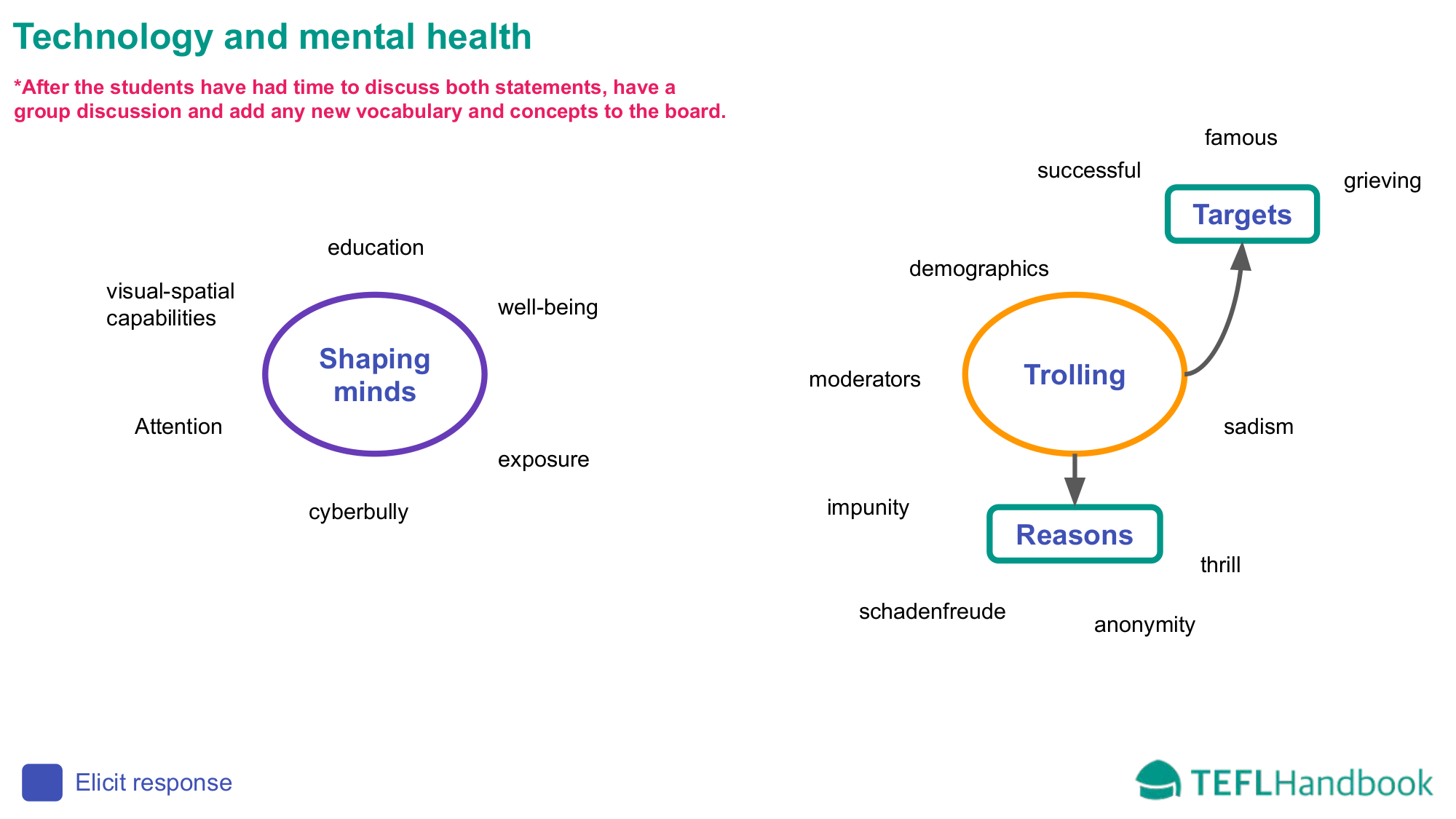
Your students will discuss statements related to technology and mental health.
Divide the students into groups of 3-4 and have them discuss the following:
- How is technology shaping the minds of today's youth?
- Internet trolling: A minor grievance or significant problem?
Give the students some time to discuss these among themselves before holding a group discussion. During the talk, add any new ideas and vocabulary to the board (See the sample board work for this lesson).
Role-play debate
Students have a class debate on a fictional scenario.
Propose the following to your students:
A tech company has invented a technology that will expose the identities of all anonymous online trolls. Before the company goes live with the product, the European Commission president (you) must sign-off on the legality of such a technology. You will hear arguments for and against a ban on this software.
Divide the class into two sides and assign each to a side of the debate. Give them 5-10 minutes prepare their arguments. If they have access to the internet and smartphones, they can research the topic online.
You will chair the debates and make sure that everyone has had a chance to say their piece, and also respond to any counter-arguments. As the president, you'll have to decide at the end. Base your decision on how each side performed in the debate. You should justify your choices.
Classroom games
Idioms: The mind
In teams, students will work through a list of idiomatic expressions and try to compose definitions.
Start by dividing the class into two teams. Then tell your students that you are going to write a list of expressions on the board and that they must attempt to write a definition for each one. When counting the scores at the end, the team with the closest interpretation wins the point.
Here is a list of idioms that you can use:
- Absent-minded: Forgetful
- All in (one's) mind: Doesn't exist
- A harebrained idea: A foolish or impractical idea.
- Off your rocker: Completely crazy.
- Come to grips with Sth: Start to understand or deal with it properly.
- A No-brainer: An easy decision
- Sharp cookie: Someone who is not easily deceived or fooled.
Access the entire
TEFLHandbook library
- 750+ Low-prep classroom activity ideas
- 1100+ Printable ESL flashcards
- 180+ ESL lesson plans
- 8 Distinct language levels
- Offline access through the TEFLHandbook app
750+ Low-prep classroom activity ideas
1100+ Printable ESL flashcards
180+ ESL lesson plans
8 Distinct language levels
Offline access through the TEFLHandbook app
Reduce your planning time and improve the way you present and teach English grammar.
